

For most commercial build-outs in Dallas-Fort Worth, hiring a general contractor is worth it, because the fee buys one party who holds the permit, the schedule, the subcontractors and the risk. Managing the trades yourself can work on a small job with no kitchen, no new plumbing and no change of use. On a restaurant, a medical office or any space that needs plan review and several inspections, the owner who self-manages takes on a second full-time job and every gap between the trades. At Harrison Construction, commercial general contracting is our daily work: 190 completed locations are on our records.
- A general contractor’s fee pays for coordination, one contract and one party who answers for the result.
- Texas has no state license for general contractors, but cities register the contractors who obtain permits, and the electrical, mechanical and plumbing trades are state licensed.
- When you manage the trades yourself, the gaps between their scopes, their insurance and their schedules are yours.
- Self-managing can work on a small cosmetic job. It rarely works on a restaurant, a clinic or a change of use.
- If you want control without the daily load, ask about construction management or an open-book arrangement.
What does a general contractor do on a Dallas-Fort Worth build-out?
A build-out is not one job. It is a dozen or more trades working in the same room in a fixed order: demolition, concrete, framing, plumbing, electrical, mechanical, fire sprinkler, fire alarm, drywall, ceilings, flooring, millwork, paint and, in a restaurant, the kitchen hood and equipment. Each trade has its own contract, its own crew and its own idea of when it should start.
The general contractor is the party that makes them one project. In practice that means:
- One price and one contract. You sign with one company. It signs with the subcontractors and suppliers.
- The permit. The contractor takes the drawings through plan review with your architect, obtains the building permit and schedules every inspection.
- The schedule. Who works when, what has to be inspected before the next trade can cover it, and which long-lead items must be ordered before the job starts.
- The scopes. Making sure every item on the drawings is in somebody’s contract, with nothing counted twice and nothing left out.
- Quality and safety. Checking the work before it is covered up, and running a safe site.
- Money and paper. Paying the trades, collecting lien waivers, tracking changes and handing over the closeout documents.
Our approach page describes how we run this at Harrison Construction: pre-construction first, then regular progress meetings and electronic project reports through construction.
Who does what: a general contractor compared with managing the trades yourself
The table lists the main jobs on a commercial build-out and who carries each one under the two arrangements.
A commercial build-out with a general contractor and without one
| Job | With a general contractor | If you manage the trades yourself |
|---|---|---|
| Contracts | One contract with the general contractor | A separate contract with every trade and supplier |
| Building permit | The contractor obtains it and answers the city’s comments with your architect | You, or a registered contractor you find, must obtain it. Trade permits go to licensed trade contractors |
| Schedule | One schedule, updated as the job moves | You sequence the trades and call each one when the space is ready |
| Gaps between scopes | The contractor’s problem under its contract | Your cost when no trade priced an item |
| Inspections | Scheduled and attended by the contractor | You schedule them and meet the inspector |
| Insurance | The contractor carries its own and collects certificates from every subcontractor | You collect and check every certificate yourself |
| Payments and lien waivers | Handled by the contractor with each payment | You pay each trade and collect each waiver |
| Punch list and warranty | One call | A call to each trade, and a debate about whose item it is |
How to read this table: nothing in the right-hand column is impossible. Each line is work and risk that moves from the contractor to you. Add up the lines and compare them with the fee you hoped to save.
Can you legally run a commercial build-out yourself in Texas?
Texas does not have a state license for general contractors. That surprises many owners, and it is one reason the idea of self-managing comes up. The rules sit in two other places: the cities, and the licensed trades.
Cities register the contractors who obtain permits. The City of Fort Worth’s Contractor Registration page says that any firm, business, individual or organization obtaining a permit related to the building, mechanical, plumbing or electrical provisions of the city’s codes must have a valid Contractor Registration on file with the Development Services Department. The page lists two exceptions: owners of single-family homes working on their own homestead, and commercial property owners installing banners on their own property. A commercial tenant finishing out a suite is not on that list.
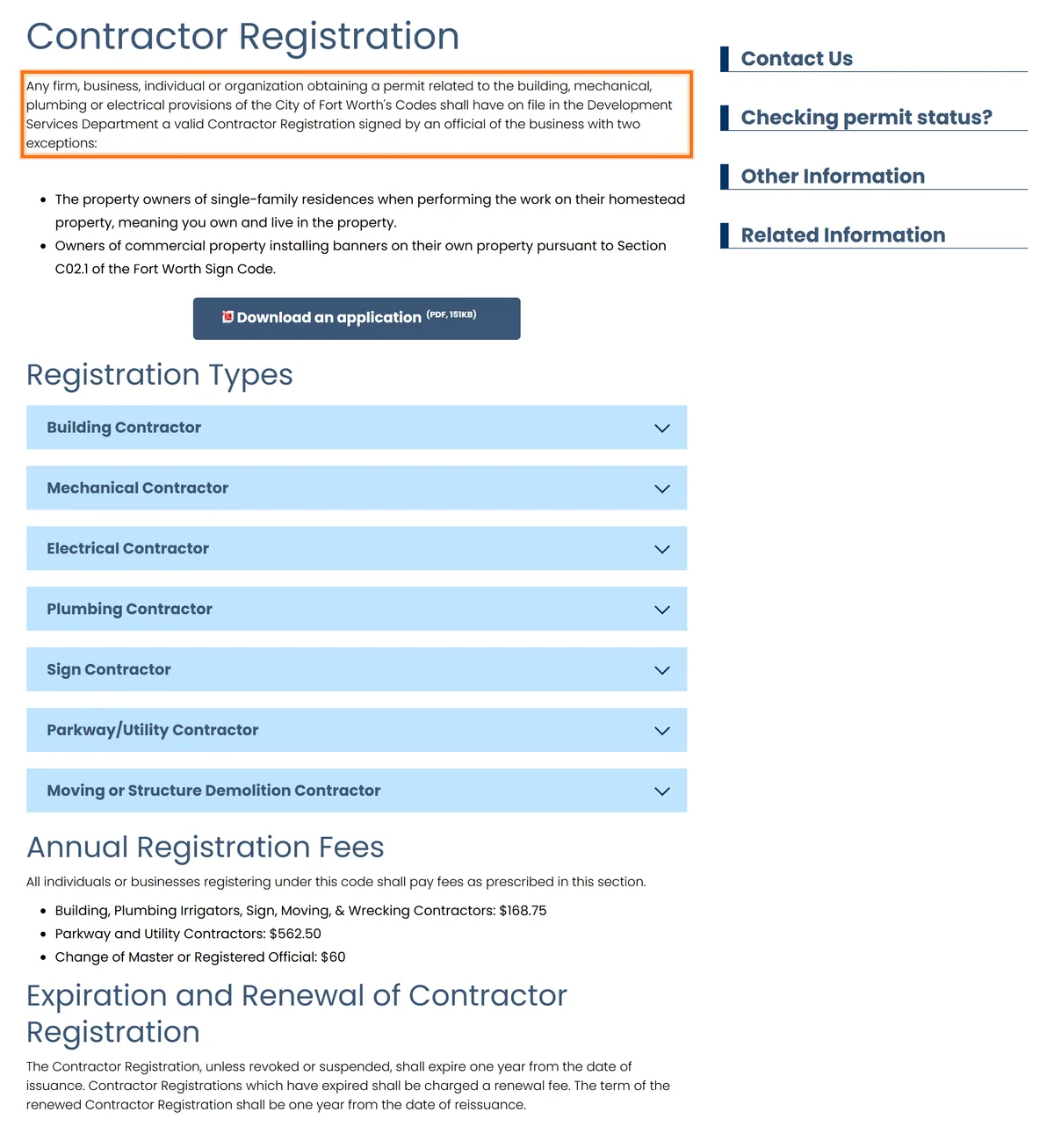
The trades are licensed by the state. The same Fort Worth page says a mechanical contractor registration requires a valid State of Texas air conditioning and refrigeration license, an electrical registration requires a State of Texas electrical contractor’s license, and a plumbing registration requires a State of Texas Master Plumber License. Electricians and air conditioning contractors are licensed by the Texas Department of Licensing and Regulation. Plumbers are licensed by the Texas State Board of Plumbing Examiners.
Dallas, Arlington, Plano and the other cities in the area have their own registration rules. Check with the permit office of the city where your space is before you plan around doing it yourself.
What you take on when you manage the subcontractors yourself
The sequence
Trades depend on each other. The plumber cannot set fixtures until the flooring is down. The ceiling cannot close until the above-ceiling inspections pass. If the electrician is a few days late, the drywall crew you booked goes to another job and comes back when it can. A general contractor absorbs these moves every day. An owner who self-manages learns about them by phone, usually while running a business somewhere else.
The gaps
Every trade prices its own scope and nothing more. Who cuts and patches the slab for the plumber? Who frames the opening for the mechanical unit? Who installs the blocking behind the millwork? Who cleans up? On a job with a general contractor, a gap between two subcontracts is the contractor’s to close. When you hold the contracts, each gap is a change order to you. Our guide to common budget surprises in commercial construction explains where these gaps usually appear.
The insurance and the liens
Your landlord’s lease almost certainly sets insurance requirements for anyone working in the building. With a general contractor, one certificate covers the relationship and the contractor collects the rest. Without one, you collect a certificate from every trade and check that each is current. In Texas, a subcontractor or supplier who is not paid can also file a lien claim, which is why lien waivers are collected with every payment. That paperwork becomes yours too.
The inspections
A commercial build-out is inspected in stages by the city, and a restaurant is also reviewed by the health department. Each inspection has to be requested at the right moment and somebody has to meet the inspector. A failed inspection stops the trades behind it until the correction is made and the inspector returns.
Your own time
This is the cost owners underestimate most. Someone has to be reachable by every trade, every day, and has to be in the space often. If that person is you, it is time taken from hiring, training, marketing and the business you are trying to open.
What the general contractor’s fee really buys
Owners often think of the contractor’s fee as a markup on work the trades would do anyway. That is not what it pays for.
- Subcontractors who show up. A trade gives its best crews and its best prices to the contractors who bring it work every month. A one-time owner is at the back of that line.
- Pricing that is complete. A contractor who builds the same kind of space again and again knows what belongs in each scope and notices what is missing from the drawings before it becomes a change.
- Someone to hold to the date. With one contract, one party is responsible for the schedule. With ten contracts, each trade is responsible only for its own days.
- A bonded and insured party between you and the risk. If something goes wrong on site, the first call is not to you.

Whether the fee is smaller than what you would lose without it depends on the job. We do not quote a rule of thumb, because a fee as a share of the job says little until the scope is known. The way to find out is to have the project priced properly. Our guide on how to prepare for a commercial construction bid shows what to hand a contractor so the number you get back is complete.
When managing the trades yourself can work, and when it does not
Self-managing is not always a mistake. The table sorts common Dallas-Fort Worth projects by how well they suit it.
Which commercial projects suit an owner managing the trades
| Project | Suits self-managing? | Why |
|---|---|---|
| Paint, flooring and fixtures in a retail suite, same use as before | Often yes | Few trades, little or no plan review, short sequence |
| Office suite with a few new walls and outlets | Sometimes | Needs a permit and licensed trades, but the sequence is simple if you have the time |
| Shell space in a strip center | Rarely | Every system is new: slab plumbing, electrical service, HVAC, restrooms, ceilings and the first certificate of occupancy for the suite |
| Restaurant, coffee shop or bakery | No | Kitchen hood, grease interceptor, gas, health review and the most inspections of any small commercial job |
| Dental or medical office | No | Plumbing, vacuum and air in the slab, imaging rooms, accessibility review and equipment vendors to coordinate |
| Change of use | No | Building and zoning review, often with upgrades the last tenant never needed |
| Ground-up building | No | Site work, utilities, structure and many more inspections |
How to read this table: the more systems that run under the slab or above the ceiling, and the more departments that review the plans, the less a project suits an owner acting as the contractor. The first two rows are the only ones where the fee you save is likely to be larger than the risk you take on.
If your project is in the lower rows, the related guides explain why each is demanding: finishing out a shell space in a DFW strip center, what to know before starting a restaurant build-out and what to plan for in a dental office build-out.
A middle path: control without the daily load
Owners usually want to self-manage for one of two reasons: to save the fee, or to keep control of the choices. If control is the real reason, there are arrangements that give it to you without making you the scheduler.
- Construction management. A construction manager works as your representative from the design stage: budgets, schedule, bidding and coordination. Our construction management page explains how this differs from a general contract.
- Open-book pricing. You see the subcontractor bids and choose among them with the contractor, so you know where the money goes.
- Owner-supplied items. You buy the furniture, the equipment or the signage directly, and the contractor coordinates the delivery and installation dates.
- Pre-construction before the commitment. You pay attention to the estimate and the schedule before you sign for the build. Our pre-construction service is built for this.
Ask a contractor which of these it offers. A contractor who refuses to show how the price is built is giving you a reason to keep looking, not a reason to do the job yourself.
How to choose the general contractor if you hire one
Deciding to hire a contractor is half of the decision. The other half is which one. A few checks do most of the work:
- Ask for the list of completed projects like yours, with the city and the size of each.
- Confirm the contractor is registered in the city where your space is and that it is bonded and insured.
- Ask who will be on site and who you will hear from each week.
- Ask how changes are priced and approved before the work is done.
- Ask what is excluded from the price, and read that list twice.
Our checklist on how to choose a commercial builder in DFW goes through each of these with the questions to ask.
How Harrison Construction works as your general contractor
Harrison Construction is a commercial general contractor in Fort Worth, founded in 2011 by Lonnie Harrison, who has more than 25 years in construction. Our records list 190 completed locations for 73 brands in 92 cities: 103 tenant finish-outs, 71 renovations and 13 ground-up buildings. Restaurants are the largest group, with 123 locations, and Dallas, Fort Worth, Plano and Arlington are the cities with the most projects.
Every project starts with pre-construction: due diligence on the space, a conceptual estimate, value engineering, a constructability review, a development schedule, bidding, subcontractor qualification and permitting. During construction, one team is responsible for the budget, the schedule, the subcontractors, quality and safety through close-out, and you get regular progress meetings and electronic project reports. We are fully bonded and insured.
If you are weighing whether to run a build-out yourself, send us the address and the drawings, or just the lease status, through our contact page, or call (817) 988-0242. We will tell you plainly what the job involves. You can see the kinds of spaces we build on our tenant finish-outs page and in our project records.
Questions owners ask
Is it worth hiring a general contractor for a Dallas build-out?
For most commercial build-outs, yes. The fee buys one contract, one schedule, the permit and inspections handled for you, and one party responsible for the gaps between the trades. The exception is a small cosmetic job with few trades and no change of use.
Does Texas license general contractors?
No. Texas has no state license for general contractors. Cities register the contractors who obtain permits, and the electrical, air conditioning and plumbing trades are licensed by the state.
Can a business owner pull a commercial building permit in Fort Worth?
The City of Fort Worth’s Contractor Registration page says anyone obtaining a permit under the building, mechanical, plumbing or electrical codes must have a valid Contractor Registration on file. The only exceptions it lists are homeowners working on their own homestead and commercial owners installing banners on their own property.
How much does a general contractor charge?
It depends on the size and the difficulty of the job, and we do not publish a rule of thumb. Ask for the fee to be shown as its own line in the estimate, next to the subcontractor costs and the general conditions, so you can see what you are paying for.
What is the biggest risk of managing subcontractors myself?
The gaps. Each trade prices only its own scope, so work that falls between two trades becomes a cost to you, and a delay by one trade moves all the others. Insurance certificates, lien waivers and inspections also become your job.
Is there a way to keep control and still use a contractor?
Yes. Ask about construction management, open-book pricing where you see the subcontractor bids, and buying your own furniture and equipment directly. Each gives you more say without making you the scheduler.
When should I talk to a general contractor?
Before you sign the lease if you can. A contractor who walks the space with you can tell you what it will take to build, which is the best moment to decide how the job should be run.